

Tail Spot Blenny

How the Tail Spot Blenny Behaves Alongside Other Blenny Species in a Reef Aquarium
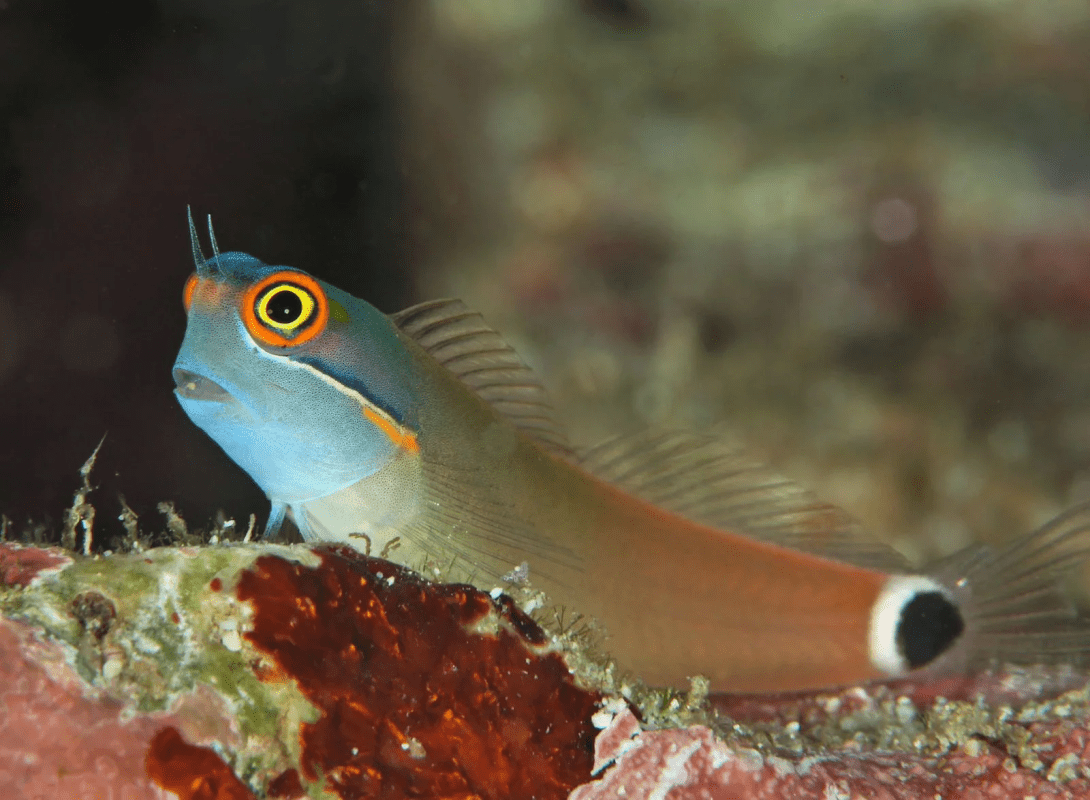
The Tail Spot Blenny (Ecsenius stigmatura) has a reputation in the reef hobby that can seem almost contradictory at first. Toward the broad community of reef fish, including clownfish, gobies, wrasses, and cardinalfish, it is reliably peaceful, unassuming, and easy to integrate. But point that same fish at another blenny, particularly one that resembles it in shape, size, or ecological role, and the dynamic shifts in a way that catches many aquarists off guard. Understanding exactly where that line falls, and why it exists, is the key to building a community that includes a Tail Spot Blenny without running into trouble.
Peaceful with Almost Everything Except Its Own Kind
Tail Spot Blennies are generally peaceful fish, but they may become territorial toward similar species. This is not a minor footnote buried in the care sheet. It is the central behavioral fact that shapes every stocking decision involving this fish. The Tail Spot is an Ecsenius blenny, a genus characterized by active grazing behavior, perching habits, and a defined territory centered on live rock. Other blennies, especially other Ecsenius species, occupy exactly the same ecological niche. They graze the same surfaces, perch in the same crevices, and claim the same spatial territory. From the Tail Spot’s perspective, another blenny is not a neutral tank mate. It is a direct competitor for every resource that matters.
The Tail Spot Blenny will defend territory from other blennies, and only one should be kept per small tank. This applies with particular force to the most commonly kept blenny species that a reef aquarist might be tempted to combine with it: the Lawnmower Blenny (Salarias fasciatus), the Bicolor Blenny (Ecsenius bicolor), the Tailspot’s closest Ecsenius relatives, and even other Tail Spot Blennies in tanks without adequate space to partition territory meaningfully.
Why the Aggression Happens and What It Looks Like
The aggression the Tail Spot displays toward other blennies is not random hostility. It is territory-driven behavior rooted in resource competition. Tail Spot Blennies use body language, including fin displays, to communicate with others, particularly during encounters with neighboring fish. In practice, this escalation moves from fin flaring and posturing to active chasing if the intruding fish does not retreat. In a small tank with no escape routes, a subordinate blenny can be harassed relentlessly, kept from feeding, and physically damaged over time.
Blennies can be quite feisty and territorial, and individual personalities vary considerably. While most Tail Spot Blennies remain manageable in their aggression, the hobby has produced enough accounts of unexpectedly aggressive individuals to make clear that personality variation is real and should not be discounted when planning a stocking list.
Tank Size Is the Primary Variable
If you want to keep multiple blennies together, your best bet is to go with an aquarium 40 gallons or larger so that fights are less frequent and each fish has room to graze and move out of the line of sight of the dominant individual. This is sound advice, though it comes with an important qualification: volume alone is not sufficient if the aquascape does not physically divide the tank into separate visual territories. A 55-gallon tank with open rock arranged in a single low mound gives two blennies nowhere to go to avoid each other. The same volume with taller, more complex rockwork that creates distinct zones, with high sections, low sections, and separated overhangs, gives the subordinate fish a realistic chance of establishing its own area and staying out of the dominant fish’s sightline.
The other critical variable in multi-blenny systems is food availability. Since Tail Spot Blennies feed on algae and biofilm growing on live rock, there may not be enough food to keep them satisfied when keeping multiple grazing animals together. Scarcity intensifies competition. A tank with abundant film algae growth across a large surface area of live rock is a meaningfully more stable environment for multiple blennies than one where grazing resources are thin and contested.
Which Combinations Are Least Risky
Not all blenny combinations carry equal risk. The most problematic pairings are two fish of the same genus, or two fish that are visually and behaviorally nearly identical. A Tail Spot and a Bicolor Blenny, for instance, share body shape, size class, grazing habits, and territorial behavior so closely that conflict in a small to medium system is nearly inevitable.
Pairings that cross further between blenny types carry somewhat lower risk, though no combination is without it. A Tail Spot alongside a Dragonet or a Mandarin, which occupies an entirely different ecological niche and poses no territorial overlap, presents no blenny-specific conflict at all. Compatible tank mates outside the blenny family include gobies, anthias, cardinalfish, and fairy wrasses: fish that share the tank without competing for the surfaces and crevices the Tail Spot claims as its own.
The Honest Bottom Line
The Tail Spot Blenny is peaceful but territorial with other blennies. In a well-sized, well-aquascaped system with abundant grazing surface and thoughtfully chosen tank mates, it is one of the most rewarding small fish in the hobby. In a crowded nano tank with another blenny competing for the same rock, it becomes a source of ongoing stress for both fish and aquarist alike. The species does not demand perfection. It demands clarity about what it is and what it needs. Give it the territory to call its own, and the Tail Spot Blenny will repay that consideration with years of personality, utility, and genuine entertainment.