
Leopard Wrasse

Leopard Wrasse for Sale – A Beautifully Patterned but Delicate Wrasse for Experienced Aquarists
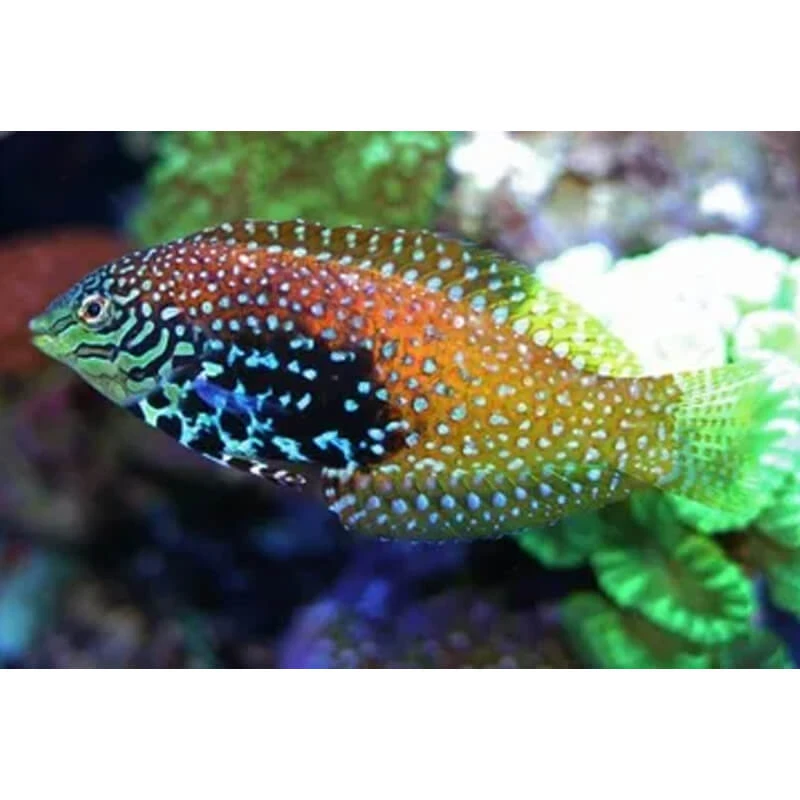
Few wrasses in the reef hobby match the visual elegance of the Leopard Wrasse (Macropharyngodon meleagris). With its intricate spotted patterning, flowing movement, and striking sexual dimorphism, it is one of the most beautiful wrasses available to marine aquarists. It is also one of the more challenging, and success with this species begins with purchasing a healthy, eating specimen from a trusted source. At Dr. Reef Quarantined Fish, every Leopard Wrasse is fully quarantined and confirmed eating before it ships to you.
A Wrasse of Exceptional Beauty
The Leopard Wrasse is native to the Indo-Pacific, ranging from the Red Sea and East Africa across to the central Pacific. It inhabits shallow reef environments with sandy substrates, rubble zones, and coral growth, where it forages actively for small invertebrates throughout the day. In the wild it is typically found in small groups consisting of a single terminal phase male and several initial phase females, displaying the natural social structure common to many wrasse species. That active, social foraging behavior translates into an engaging and lively presence in the reef aquarium when the species is kept in appropriate conditions.
Appearance and Size
The Leopard Wrasse is a sexually dimorphic species with striking differences between male and female coloration. Initial phase females display a white to cream body covered in a dense pattern of black spots and orange to red edging that creates a rich, leopard-like appearance. Terminal phase males develop vivid green and blue tones with intricate spotted and lined patterning across the body, representing one of the more dramatic male colorations in the wrasse family. Adults typically reach 4 to 6 inches in length, making this a mid-sized wrasse suitable for reef systems of moderate to generous size.
Aquarium Requirements
The Leopard Wrasse requires a well-established reef aquarium with a deep, fine sand bed of at least 3 to 4 inches. This species sleeps buried in the sand and dives into the substrate when startled, making adequate sand depth a non-negotiable requirement rather than a preference. A minimum of 75 gallons is recommended, with larger systems providing more foraging territory and swimming space. Water quality must be maintained at a consistently high standard. The Leopard Wrasse is sensitive to elevated nitrate, declining water parameters, and any form of nutritional deficiency, all of which can cause rapid deterioration in a species that carries relatively low fat reserves. A secure, tight-fitting lid is essential, as this species will jump from open aquariums.
Feeding
Feeding is the central challenge of keeping the Leopard Wrasse successfully. In the wild it feeds almost exclusively on small hard-shelled invertebrates including foraminifera, small crustaceans, and worms found in the sand and rubble. In captivity transitioning this species onto frozen prepared foods requires persistence and a system with abundant natural microfauna to supplement its diet during the adjustment period. Frozen mysis shrimp, copepods, and small meaty frozen preparations are the best starting points. A refugium producing a steady supply of copepods significantly improves the chances of long-term success with this species. This is precisely why purchasing a specimen that is already eating prepared foods is so important.
Temperament and Tank Compatibility
The Leopard Wrasse is peaceful toward most tank inhabitants and is a compatible and practical choice for community reef systems. It may show mild competition with other wrasses of similar size and feeding style, but serious aggression is uncommon in well-stocked systems with adequate space. It is considered reef safe and poses no meaningful threat to corals or sessile invertebrates. It may occasionally consume very small ornamental shrimp and other tiny crustaceans as part of its natural foraging behavior, so housing it with larger, more robust invertebrates is advisable.
Why Buy from Dr. Reef
The Leopard Wrasse has a well-known reputation for being difficult, and most failures with this species can be traced directly to purchasing a fish that was not eating reliably at the point of sale. At Dr. Reef Quarantined Fish, every Leopard Wrasse undergoes an extended quarantine and observation period before being offered for sale. Each fish is treated prophylactically, monitored carefully for health and body condition, and confirmed eating a variety of frozen foods before it ships. That single commitment addresses the primary risk factor associated with this species and gives you a genuine foundation for success with one of the most beautiful wrasses in the hobby.